Last Updated on September 9, 2026 by Practical Astrophotography Staff
Astrophotography has always been a negotiation with the atmosphere. Transparency, seeing, moonlight, and local skyglow decided whether a night was worth the drive. In 2026 those old constraints are still there. Two newer ones sit on top of them.
The first is orbital. Low-Earth-orbit constellations have turned a clean long exposure into a rare event. A single unstacked frame of a rich field now routinely carries at least one streak. On some nights it carries several.
The second is terrestrial. Sky brightness has been climbing for years, and most imagers do not live under the Bortle 1 and 2 skies that destination articles on this site celebrate. The backyard is brighter than it was a decade ago. The satellites are brighter and more numerous than they were five years ago. Neither trend is reversing on a hobbyist’s timeline.
The useful response is not despair. It is a change in how sessions are planned and how data is combined. The sky is still full of targets. The workflow has to assume contamination instead of hoping for a pristine sub.
What changed
A satellite trail is a moving point source that draws a line across the sensor during an exposure. Older imagers remember the occasional Iridium flare or a random rocket body. Those were incidents. Today the background population is measured in the tens of thousands of active spacecraft, with Starlink the largest single fleet and other constellations adding to the total. The count is still rising.
Not every satellite is a problem in every frame. Many are faint. Some miss your field. A few — especially large, freshly launched, or specular objects — are bright enough to saturate a line of pixels. Wide-field lenses and short-focal-length refractors collect more of them because they see more sky. Long single exposures collect more of them because the satellite has more time to cross.
Light pollution is a different contaminant. It is a gradient and an elevated noise floor, not a line. It steals contrast from broadband targets — galaxies, reflection nebulae, dust — and it makes stretching harder. Narrowband emission objects survive it better. That split is now one of the main planning decisions of the hobby.
Plan the night as if trails are normal
You cannot schedule a satellite-free sky the way you schedule a new Moon. You can still stack the odds.
Prefer targets that tolerate short subs. A 30-second or 60-second exposure on a fast optic will record a shorter streak than a 300-second exposure on a slow one. More importantly, it gives the stacker more independent samples. Rejection algorithms need a population. Six long lights with three trails is a weaker data set than forty short lights with twelve trails.
Dithering-and-why-should-i-enable-it-when-guiding" target="_blank" rel="noopener noreferrer nofollow">Dithering still earns its keep. A trail that lands on the same pixels in every sub is harder to reject. A dithered trail does not. If you already dither to control walking noise and residual hot pixels, you are also helping with satellites.
Keep taking Calibration frames. Darks, flats, and bias or dark-flats do not remove streaks. They do keep the background well-behaved so that rejection has a clean statistic to work with. A poorly calibrated stack hides trails in a mottled mess instead of isolating them.
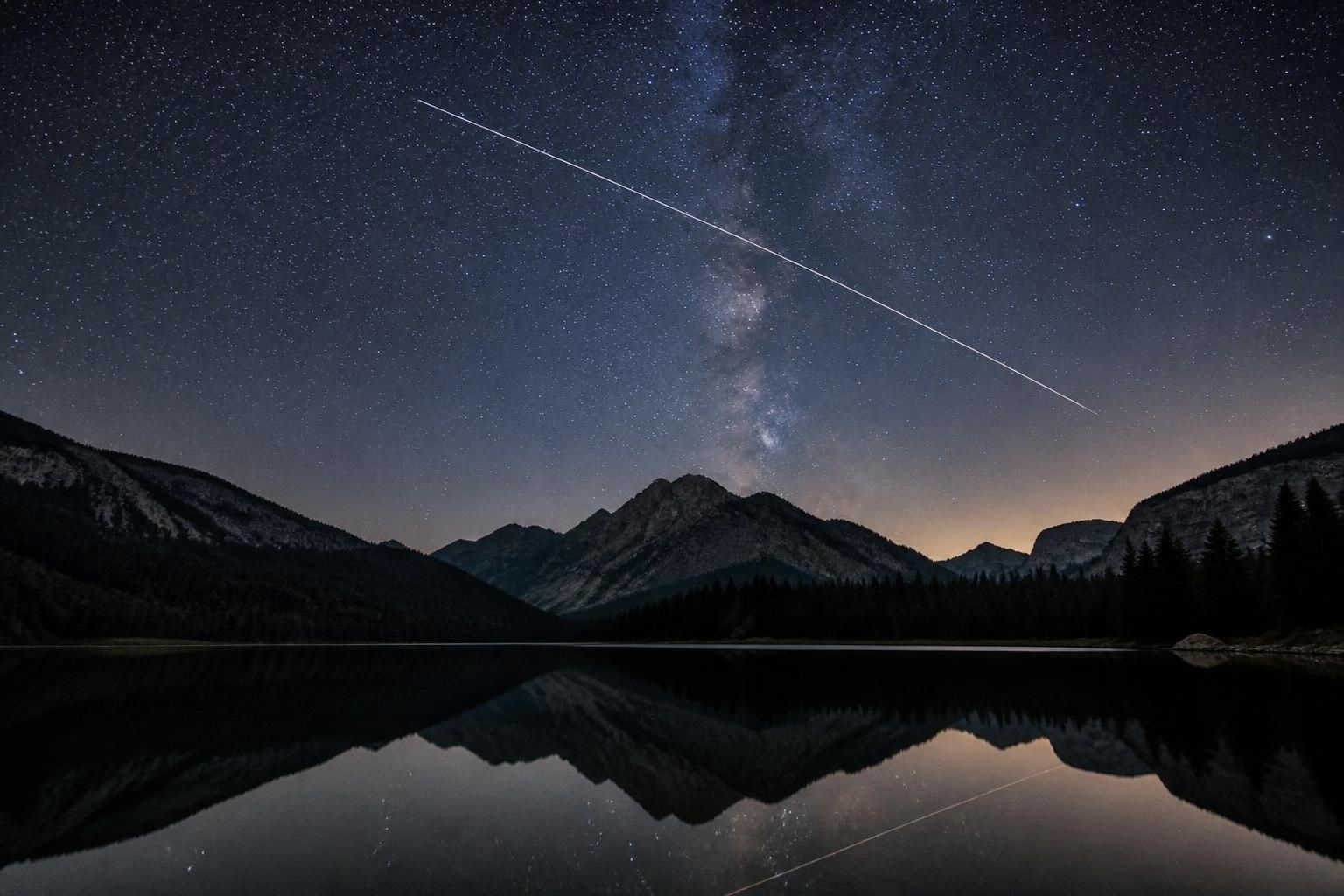
For wide-field landscape work the math is harsher. A single Milky Way exposure cannot reject a trail that crossed during that frame. You either accept the line, clone it with care, shoot a burst of shorter frames and stack them, or time the shot. Tools now exist that estimate trail windows from the public catalog for a given site and pointing. They are imperfect. They are still better than guessing.
Moon phase and transparency remain the first filters. A satellite-rich night under a clean, dark sky is still more productive than a satellite-poor night under washed-out haze. Do not let the new problem erase the old ones.
Stack so the streaks lose the vote
The standard defence is statistical, and it is the same idea whether you work in PixInsight, Siril, AstroPixelProcessor, or another stacker.
A trail is bright in one frame and absent in the others. At each pixel, the stacker looks across the set, finds values that do not belong, and discards them before it averages or medians the rest. Winsorized sigma clipping in PixInsight’s ImageIntegration, kappa-sigma clipping in Siril, and similar rejection modes in other tools are all versions of that vote.
The method needs enough frames. A handful of subs is not a vote. It is a tie. Practical experience across the community is consistent: plan for at least a dozen lights on a given pointing, and preferably two or three dozen, if trails are common in your field. Comet imagers and mosaic shooters feel this first because they already work with fewer frames per panel.
Rejection is not magic. A trail that saturates a line can leave a faint residual if the clip is too gentle or the sample is too small. A trail that appears in many aligned frames — rare, but possible on a busy field with poor dithering — can survive. Blink the lights before you stack. If one frame is a scribble of flares and passing aircraft, drop it. Losing three minutes of integration is cheaper than painting a ghost later.
When the stack is thin, pre-cleaning individual lights is an option. Several current tools attempt to detect linear features and inpaint them before integration. Use them as a backup for short sequences, not as an excuse to skip rejection. The stacker’s statistic is still the cleaner solution when you have the frame count.
Do not average a set of trailed lights and hope to clone the result. Once a streak is baked into a mean stack, it is part of the signal. Rejection has to happen at integration.
Work with the brighter background
Satellite trails are lines. Light pollution is a slope. They ask for different tools.
From a typical suburban backyard, broadband galaxies and dusty reflection regions are harder than they were. Emission nebulae are not. A dual-band or tri-band filter on a one-shot-color camera, or true narrowband on a mono camera, still reaches contrast that broadband cannot from the same driveway. That is why filter use has become normal rather than specialized.
Gradient removal belongs early in processing. Whether you use a polynomial background extraction, a tool such as GraXpert, or the equivalent process in PixInsight, the goal is the same: take out the uneven wash so the stretch does not lift one corner into mud. Do this before you decide the image “has no data.” Often the data is there and the gradient is sitting on it.
Drive when the target requires it. Wilderness and dark-sky destinations on this site exist because some objects will not be saved by a filter. Galaxies, integrated flux nebula, and natural-color Milky Way cores still want dark sky. A Saturday night at a Bortle 2 park will outperform a month of filtered galaxy attempts from Bortle 7. Choose the battle.
For Milky Way nightscapes, shorter tracked or fixed exposures and a stack of frames beat one long, hopeful shutter click. The 500 Rule still keeps stars from trailing on a fixed tripod. Stacking those shorter frames then does the same job for noise — and for the occasional aircraft or satellite — that deep-sky rejection does at the telescope.
What is not worth doing
Do not wait for a policy change to start imaging. Advocacy for darker skies and responsible satellite brightness is worthwhile. It is not a session plan.
Do not throw away an entire night because two lights have streaks. That is the old habit. The new habit is to collect enough frames that the streaks become a rounding error.
Do not treat every bright line as a satellite. Airliners, meteors, and internal reflections exist. Meteors are worth keeping. Airliners are usually worth discarding if they dominate a frame. Reflections are a flats and hood problem.
Do not process a trail out of a single JPEG hero shot and call the workflow complete. If the goal is a deep-sky image, the answer lives in the stack. If the goal is a single nightscape, shoot extra frames at the same composition so you have a clean replacement for the one that got hit.
A working night in 2026
A practical session now looks like this.
Pick a target that matches the sky you actually have. Emission Nebula from the suburbs. Galaxy or dust from a dark site if you can travel. Set exposures short enough that a trail is a thin line rather than a fat burn, and take more of them than you would have in 2016. Dither. Calibrate. Stack with aggressive-enough rejection that outliers die and nebulosity does not.
If you are on a camera and a tripod instead of a telescope, shoot a sequence, not a single frame. Check the first files for focus and for a streak across the subject. Adjust and keep going.
The image that comes off that night will not be the empty-sky plate of a previous generation. It will still be an image of the object. That is the standard that matters.
Final thoughts
The night sky in 2026 is more crowded overhead and more washed from the ground. Both facts are easy to turn into a eulogy for amateur astrophotography. They are also easy to overstate. People are producing better data now than they were when the sky was emptier, because sensors, mounts, and software improved on the same timeline that the contaminants did.
The craft is the same one this site has always argued for. Understand the system. Collect honest calibration. Take enough lights. Process with a method instead of a filter preset. The new step is only this: assume a trail will appear, and build a data set that can outvote it.
Go out on the next clear night. The satellites will be there. So will the nebula.